 Vanoor
Guide
Trail running with an Apple Watch: navigation, offline maps, battery and what the Ultra actually adds
On the road, an Apple Watch mostly needs to count kilometres. On a trail it needs to keep you on the route, with no phone signal, under trees, for hours. That is a different job, and Apple's own Workout app does not do it — it records where you went and never shows where to go. Here is what changes on trails, what to set up before you leave the car, and whether you need an Ultra.
1. Navigation: following a route with no signal
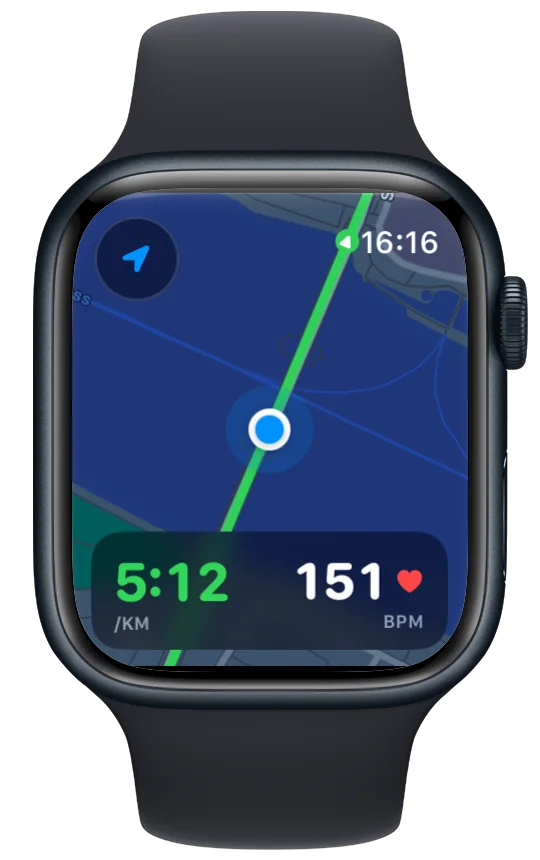
Trail navigation on the Watch means three things: the route line, your position on it, and a warning when you leave it. All three have to work with the phone at home and no reception. With Vanoor you import the GPX (from the race site, Komoot, Strava, AllTrails — anything that exports GPX) or draw the route on the iPhone; it syncs to the Watch with its map already attached. On the trail you see the line, your heading, kilometre markers and distance to go, and the wrist buzzes when you drift off — the way a Garmin does it, not turn-by-turn street names, because trails don't have any.
Off-route is where trail apps earn their keep: a junction in a forest looks like every other junction, and the buzz 40 metres down the wrong fork saves a 2 km detour. Vanoor's off-route warning is distance-based and clears itself when you're back on the line.
2. Offline maps: the tiles must already be on the Watch
Apple Maps on the Watch needs a connection; "offline maps" in Apple's sense are areas you save on the iPhone. For a phone-free trail run the tiles have to live on the Watch. Vanoor renders a corridor of map along the route on the iPhone when the route syncs and ships it with the route, so the map on your wrist is the same map with zero downloads mid-run — the offline maps guide covers the details, and running without your phone the checklist before you leave.
3. GPS under trees and in valleys
Dense canopy and steep valley walls degrade GPS on any watch: positions wobble, distance reads long on switchbacks and short on straight tree-lined sections. Two things help. The Ultra's dual-frequency (L1 + L5) GPS is noticeably better in exactly these conditions — it is the single biggest reason to choose an Ultra for trails. On any model, since watchOS 9 the Watch fuses accelerometer stride data with GPS, so short GPS dropouts don't produce the jumps they used to. Expect trail distances to disagree with the race's official number by a few percent; everyone's watch does.
4. Pace is meaningless on a climb — pace by effort
A 12% climb at 9:00/km can be a harder effort than 4:30/km on the flat. On trails the numbers to run by are heart rate and, on a recent Watch, running power, which reacts to gradient within seconds. Build a screen with power big and heart rate beside it, and let pace live on another page — see which metrics belong where and running power explained. For long ultras, a zone 2 ceiling with a haptic when you exceed it is the most reliable pacing tool there is, and walking the steep climbs at that same heart rate is not cheating — it is how the sport is run (run/walk on Apple Watch).
5. Battery for a long day out
A well-behaved app gets a Series watch through 6–7 hours of GPS and an Ultra through 12; Low Power Mode with fewer GPS readings stretches both, at the cost of a coarser track. The map is the big variable: an app that redraws or downloads it continuously will halve those numbers. Keep the metrics screen up and swipe to the map at junctions — the battery guide has the full checklist, including charging on the move for ultras.
6. Series or Ultra for trail running?
| Apple Watch Series / SE | Apple Watch Ultra | |
|---|---|---|
| GPS in forest and valleys | Good (fused with stride) | Better (dual-frequency) |
| Battery, GPS workout | ~7 h | ~12 h, much more in Low Power |
| Screen in sun / with gloves | Fine | Brighter, bigger, Action button |
| Toughness | Fine for most trails | Titanium, sapphire, rated deeper |
| Route navigation | Identical — it's the app, not the watch | |
For runs under four hours on normal trails, a Series watch with the right app does everything the Ultra does. Ultras, alpine terrain and anyone who has lost a finish to a dead watch: get the Ultra.
Before you leave the car — the 60-second checklist
- Route synced and showing "On Watch" in Vanoor's route list; tiles attached.
- Watch at 100%; Low Power Mode on if the day is over ~5 hours.
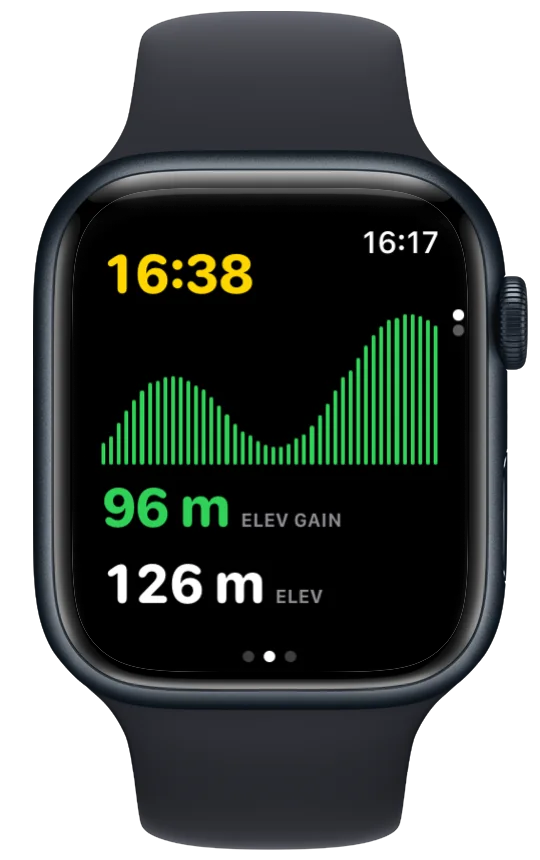
- Screens: metrics page first (power/HR), map second, elevation third.
- Phone stays in the pack or the car — the Watch doesn't need it.
- Off-route haptic on; know what the buzz feels like before you need it.
Trail running on Apple Watch — quick answers
Can Apple Watch navigate trails without a phone?
With a third-party app that stores the route and its map on the Watch — yes. Apple's Workout app records but doesn't navigate.
Does Apple Watch have a trail running mode?
No specific mode; Outdoor Run covers it. Vanoor treats trail runs as runs with a route, offline map and elevation profile.
Is the Apple Watch Ultra worth it for trail running?
For long or alpine days, yes — better GPS under cover and twice the battery. For shorter trails a Series watch is enough.
Which trail running app for Apple Watch?
It depends what you want on the wrist; see Footpath vs. WorkOutDoors vs. WristTopo vs. Vanoor.
Last checked 18 September 2026.
Keep the Watch. Upgrade the run.
Vanoor — offline route navigation, race pacing and structured workouts on the Apple Watch you already own.
Get Vanoor 7-day free trial · $9.99 once, no subscription · no account