 Vanoor
Guide + calculator
Heart rate zones calculator for runners — built on the published research, not a rule of thumb
Most heart-rate zone charts come from "220 minus your age" and five evenly spaced bands. Neither is science. The formula is a 1971 rule of thumb that was never validated, and the bands are whatever the watch vendor picked. This calculator uses the published equations for maximal heart rate, the Karvonen heart-rate-reserve method, and the five-zone scale used by the Norwegian Olympic Federation as reported by Seiler — every number below has a citation you can check.
| Zone | What it is | % of max | % of reserve | bpm |
|---|
Where the numbers come from
Maximal heart rate: why not 220 − age
The "220 − age" formula is usually attributed to Fox, Naughton and Haskell (1971), who drew a line through a handful of published group averages; it was never derived from a study designed to predict maximum heart rate, and its error is around ±10–12 bpm for an individual [1][2]. Two large studies since have produced better-founded equations:
- Tanaka, Monahan & Seals (2001) pooled 351 studies (18,712 subjects) and validated the result in 514 people in the lab: HRmax = 208 − 0.7 × age, independent of sex and training status [3]. This is the calculator's default.
- Nes et al. (2013) measured 3,320 healthy Norwegians aged 19–89 in the HUNT Fitness Study: HRmax = 211 − 0.64 × age, with a standard error of 10.8 bpm [4]. It gives slightly higher values for older runners.
Both papers say the same thing about individuals: age explains most of the variation between people, but any single runner can be 10 bpm either side of the line. If your zones feel wrong, the estimate is the first suspect.
The Karvonen method: why resting heart rate matters
Karvonen, Kentala and Mustala (1957) trained Finnish recruits at different intensities and found that the training effect tracked the fraction of the reserve between resting and maximal heart rate, not the fraction of maximum alone [5]. The formula:
target HR = resting HR + (max HR − resting HR) × intensity
It matters because a fit runner with a resting HR of 45 and an unfit one with 75 can share a max of 185 yet have very different zones; percent-of-max puts them in the same bands. Karvonen's method is the one recommended in the American College of Sports Medicine's position stand, which also defines the intensity categories used for the "% of reserve" column: very light <30%, light 30–39%, moderate 40–59%, vigorous 60–89%, near-maximal ≥90% of reserve [6]. The calculator maps those to five zones (Z1 30–40%, Z2 40–60%, Z5 90–100%) and splits ACSM's wide "vigorous" band at 75% into Z3 and Z4 — that split is our convention for runners, not a published boundary, so treat the Z3/Z4 line as soft.
The five-zone scale
The "% of max" column is the five-zone scale used by the Norwegian Olympic Federation for cross-country skiers, rowers and biathletes, as tabulated by Stephen Seiler [7]: zone 1 at 60–72% of max (blood lactate 0.8–1.5 mmol/L), zone 2 at 72–82% (1.5–2.5), zone 3 at 82–87% (2.5–4), zone 4 at 88–92% (4–6) and zone 5 at 93–100% (6–10). The same review explains why elite endurance athletes spend roughly 80% of sessions in zones 1–2 and 20% in zones 4–5, with little in the middle — the "polarised" distribution first quantified by Seiler and Kjerland [8].
How to measure your real maximum (it beats any formula)
Warm up 15 minutes, then run a hard 3-minute effort up a moderate hill, jog down 2 minutes, and repeat — the highest value in the second or third rep is within a beat or two of your true maximum. Do it rested, with a chest strap rather than the wrist sensor, and never on a day you feel unwell. Enter the number under "I measured it" above. Alternatively, the peak from a 5 km race is usually within 3–5 bpm of max.
Wrist sensor or strap for zone training?
In a Cleveland Clinic comparison against ECG, the Apple Watch's optical sensor reached a concordance of 0.91 versus 0.99 for a Polar chest strap, and every wrist device lost accuracy as exercise intensity rose [9]. For zone 1–2 running the wrist is fine; for threshold and VO2max intervals, where the number changes fast and the zone is narrow, a strap earns its place.
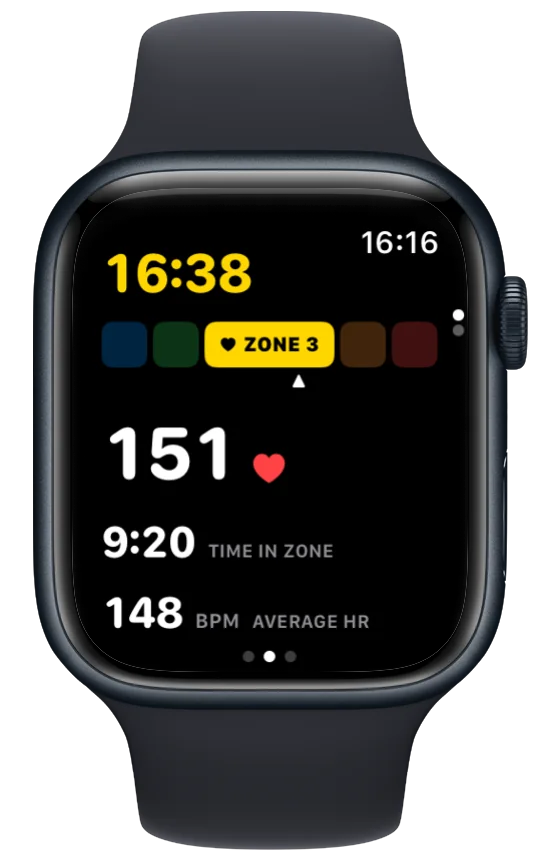
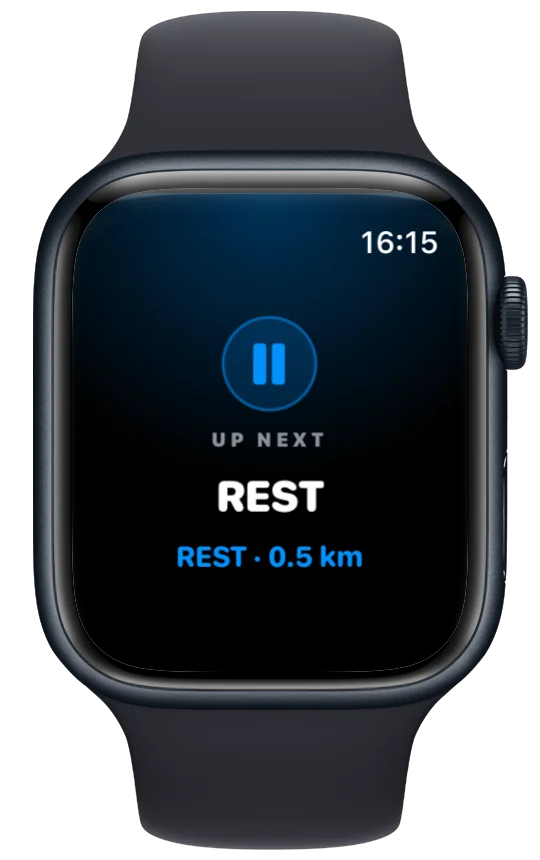
Running your zones on Apple Watch
Two places to put the numbers. Apple's Health app lets you set zones manually (Health → Heart Rate → Heart Rate Zones → Manual) and Apple's Workout app uses those. Vanoor keeps its own zones — by default an age estimate, or exact bounds you type in under Settings → HR Zones on the iPhone — and syncs them to the Watch, so the live heart-rate screen, zone alerts and workout steps with a zone target all use the same five bands. Enter the bpm from the table in both and your wrist and Apple Health will agree. What each zone is for, in practice:
- Z1–Z2 (most of your week): easy and long runs; conversation possible; the bulk of aerobic development. See long-run battery for the practicalities.
- Z3: marathon-ish effort. Useful in small doses; the "grey zone" trap is living here every day.
- Z4: threshold — 20–40 minutes total per session, as tempo or cruise intervals. The marathon pacing guide shows how it maps to race pace.
- Z5: VO2max intervals, 3–5 minutes each; heart rate lags, so judge the first minute by pace or power.
Heart rate zones — quick answers
Which max heart rate formula is most accurate?
Tanaka (208 − 0.7 × age) and Nes (211 − 0.64 × age) are both derived from large measured samples and outperform 220 − age, but all three carry roughly ±10 bpm for an individual. A measured max is better than any of them.
Should I use Karvonen or percent of max?
Karvonen if you know your resting heart rate (take it lying down on waking); it adapts the zones to your fitness. Percent of max is fine if you don't.
What is zone 2 heart rate?
About 72–82% of max on the five-zone scale, or 40–59% of reserve on the ACSM scale — an easy, conversational pace with blood lactate under ~2 mmol/L. If "zone 2" feels absurdly slow, your estimated max is probably too high.
Are Apple Watch heart rate zones accurate?
The sensor is accurate at easy intensity and drifts at high intensity; the zones themselves are only as good as the max they're based on. Set them manually from this calculator, and use a strap for intervals.
References
- Fox SM, Naughton JP, Haskell WL. Physical activity and the prevention of coronary heart disease. Ann Clin Res. 1971;3:404–432.
- Robergs RA, Landwehr R. The surprising history of the "HRmax = 220 − age" equation. J Exerc Physiol Online. 2002;5(2):1–10.
- Tanaka H, Monahan KD, Seals DR. Age-predicted maximal heart rate revisited. J Am Coll Cardiol. 2001;37(1):153–156. doi:10.1016/S0735-1097(00)01054-8
- Nes BM, Janszky I, Wisløff U, Støylen A, Karlsen T. Age-predicted maximal heart rate in healthy subjects: the HUNT Fitness Study. Scand J Med Sci Sports. 2013;23(6):697–704. doi:10.1111/j.1600-0838.2012.01445.x
- Karvonen MJ, Kentala E, Mustala O. The effects of training on heart rate: a longitudinal study. Ann Med Exp Biol Fenn. 1957;35:307–315.
- Garber CE, Blissmer B, Deschenes MR, et al. American College of Sports Medicine position stand. Quantity and quality of exercise for developing and maintaining cardiorespiratory, musculoskeletal, and neuromotor fitness in apparently healthy adults: guidance for prescribing exercise. Med Sci Sports Exerc. 2011;43(7):1334–1359. doi:10.1249/MSS.0b013e318213fefb
- Seiler S. What is best practice for training intensity and duration distribution in endurance athletes? Int J Sports Physiol Perform. 2010;5(3):276–291 (Table 1). doi:10.1123/ijspp.5.3.276
- Seiler KS, Kjerland GØ. Quantifying training intensity distribution in elite endurance athletes: is there evidence for an "optimal" distribution? Scand J Med Sci Sports. 2006;16(1):49–56. doi:10.1111/j.1600-0838.2004.00418.x
- Wang R, Blackburn G, Desai M, et al. Accuracy of wrist-worn heart rate monitors. JAMA Cardiol. 2017;2(1):104–106. doi:10.1001/jamacardio.2016.3340
Last checked 18 September 2026.
Keep the Watch. Upgrade the run.
Vanoor — offline route navigation, race pacing and structured workouts on the Apple Watch you already own.
Get Vanoor 7-day free trial · $9.99 once, no subscription · no account