 Vanoor
Guide + calculator
Zone 2 running: what it is, your zone 2 heart rate, and how to hold it on Apple Watch
On this page
Zone 2 is easy running: the effort where you can still talk in full sentences, your breathing is deep but calm, and blood lactate stays low. Endurance athletes spend most of their training time there. It is also the most misunderstood number on a running watch, because different apps mean different things by "zone 2" and the formula behind your zones can be ten beats out. This guide has a calculator that shows the three common definitions side by side, a chart by age, a way to check you are really in zone 2, and how to hold it on your wrist.
Zone 2 heart rate calculator
| Method | What it means | Zone 2 |
|---|
Hold it on your Apple Watch
Send a zone 2 run to Vanoor: one step with your heart-rate band as the target. On the run the Watch shows where you are inside the band; with Settings → Alerts → Off-zone alert on, it taps your wrist when you leave it.
On an iPhone with Vanoor, Send to Vanoor opens the app with this run. On a computer it shows a QR code to scan with your iPhone.
Saved as a .vanoor file. On iPhone, open it from Downloads in the Files app and choose Vanoor; from a computer, AirDrop or email it to your iPhone.
No Vanoor yet? Get it on the App Store. It's 7 days free, then $9.99 once. Everything is computed in your browser.What "zone 2" actually means
Two different things share the name, which is why two apps can give you two different numbers:
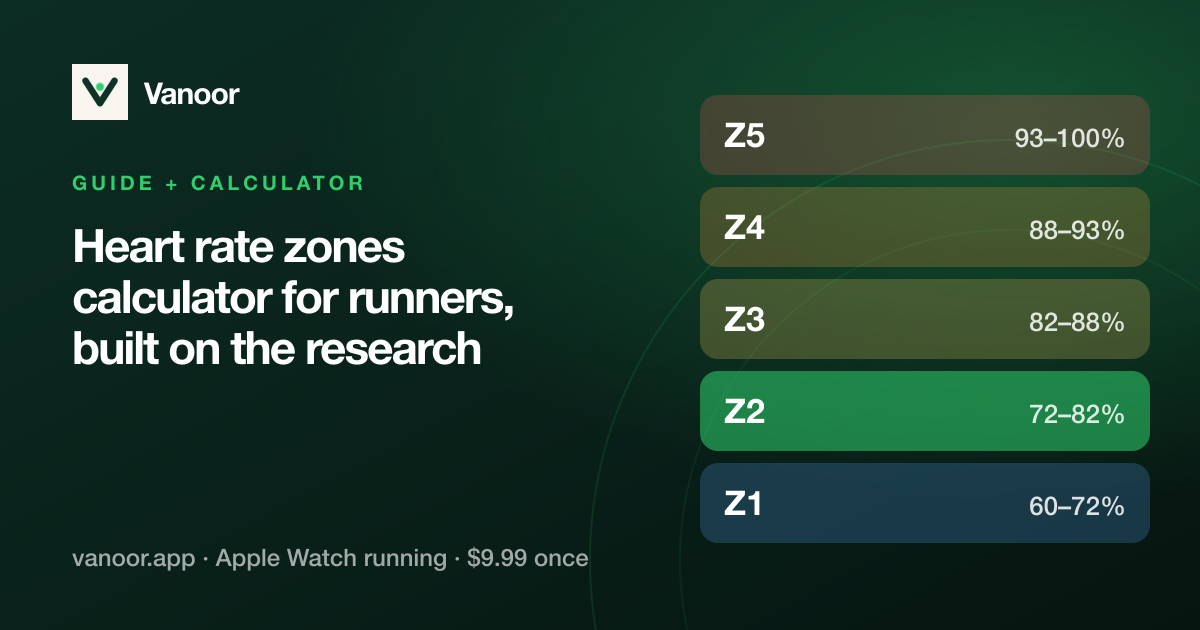
- The second of five heart-rate zones. On the five-zone scale used by the Norwegian Olympic Federation, as tabulated by Stephen Seiler, zone 2 is 72–82% of maximum heart rate, with blood lactate around 1.5–2.5 mmol/L [1]. Apple Watch presents its zones the same way, as five segments that are each a percentage of your maximum, calculated from your Health data [8].
- A physiological threshold. The zone 2 that podcasts talk about comes from sports physiologists like Iñigo San-Millán: the highest effort you can hold before blood lactate starts to climb, where fat oxidation is near its peak. San-Millán and Brooks measured it in the lab in professional cyclists, moderately active people and people with metabolic syndrome. The fitter the group, the more fat they burned and the less lactate they produced at the same relative effort [3]. That boundary is individual; a formula can only guess at it.
In practice both land in the same place: an easy, conversational effort. The formula tells you where to start; your breathing tells you whether you are there.
Zone 2 heart rate by age
Estimated with Tanaka's equation for maximum heart rate (208 − 0.7 × age, pooled from 351 studies [4]) and the five-zone 72–82% band [1]. The last column is Maffetone's 180 − age, for comparison. It is a ceiling, not a band [9].
| Age | Est. max HR | Zone 2 (72–82% of max) | 180 − age |
|---|---|---|---|
| 20 | 194 | 140–159 | 160 |
| 25 | 190 | 137–156 | 155 |
| 30 | 187 | 135–153 | 150 |
| 35 | 184 | 132–151 | 145 |
| 40 | 180 | 130–148 | 140 |
| 45 | 176 | 127–144 | 135 |
| 50 | 173 | 125–142 | 130 |
| 55 | 170 | 122–139 | 125 |
| 60 | 166 | 120–136 | 120 |
| 65 | 162 | 117–133 | 115 |
| 70 | 159 | 114–130 | 110 |
Computed from the equations above and rounded to the beat. Any single runner can sit 10 bpm either side of an age estimate; a measured max (see the heart-rate zones calculator) is better.
How to check you are really in zone 2: the talk test
You do not need a lab. If you can speak comfortably in full sentences, you are below the ventilatory threshold; the moment speaking stops being comfortable, you have crossed it. Foster and colleagues reviewed the evidence and found the talk test a consistent, practical marker of exercise intensity [6]. Use it to calibrate the number: run 20 minutes on flat ground at the top of your zone 2 band. Chatting easily? The band is right. Breathing hard? Your estimated max is too high, so lower the band by five beats and try again.
Why zone 2 feels so slow
- Most runners run their easy runs too fast. Zone 2 is supposed to feel too easy on the day. Seiler's review of elite endurance athletes found roughly 80% of their sessions at low intensity and most of the rest well above threshold, with little in the "comfortably hard" middle [1][2].
- Heart rate drifts. On a long steady run your heart rate creeps upward even at the same pace, and more so in the heat and as you lose fluid [7]. Hold the heart rate and let the pace fall, or accept a drift of a few beats in the last third and slow down if it keeps climbing.
- Hills count. Zone 2 up a hill can mean walking. That is fine: walking a climb at zone 2 heart rate trains the same system, and run/walk is a legitimate way to stay in zone while fitness catches up.
- The estimate may be wrong. If your true maximum is ten beats lower than the formula, "zone 2" from the formula is really zone 3.
What pace is zone 2?
There is no zone 2 pace. It is whatever pace keeps your heart rate in the band today, on this course, in this weather. Find yours: after a 10-minute warm-up, run 20–30 minutes on flat ground holding the band and note the average pace. Repeat every few weeks; as your aerobic fitness improves, the same heart rate buys a faster pace. That trend is the most honest progress marker easy running has.
How much zone 2?
For most runners, most of it. The polarised pattern Seiler describes, with about 80% of sessions easy and the rest properly hard, is a good default [1][2]. In a five-run week that is three or four easy runs plus one or two quality sessions (intervals, tempo, a long run with a faster finish). Zone 2 runs can be anything from 30 minutes to the long run. Keep the easy days easy so the hard days can be hard.
Zone 2 on Apple Watch
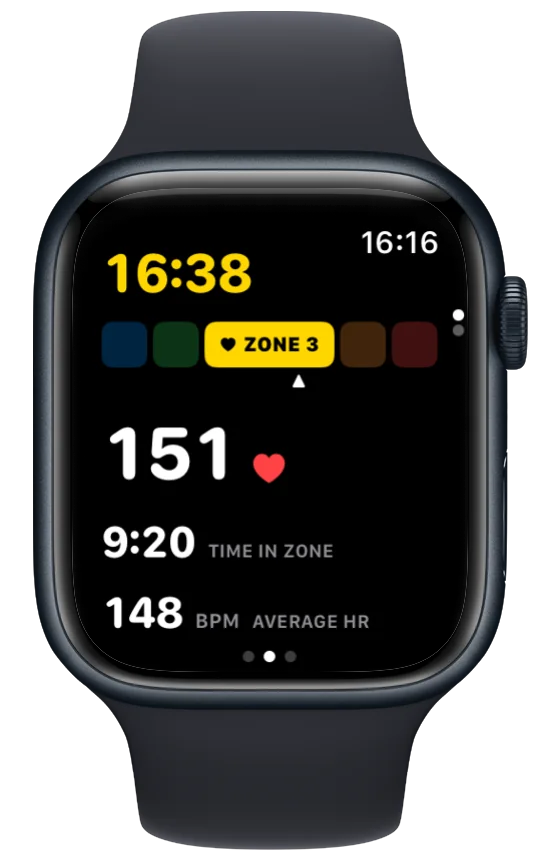
During a run, Apple's Workout app shows a Heart Rate Zones view with your zone, heart rate and time in zone. The zones are calculated from your Health data (you need your date of birth in the Health app), and you can set zones 2–4 manually: on the Watch, Settings → Workout → Heart Rate Zones → Manual, or in the Watch app on your iPhone under My Watch → Workout [8]. Put the zone 2 numbers from the calculator in there and the Workout app agrees with them.
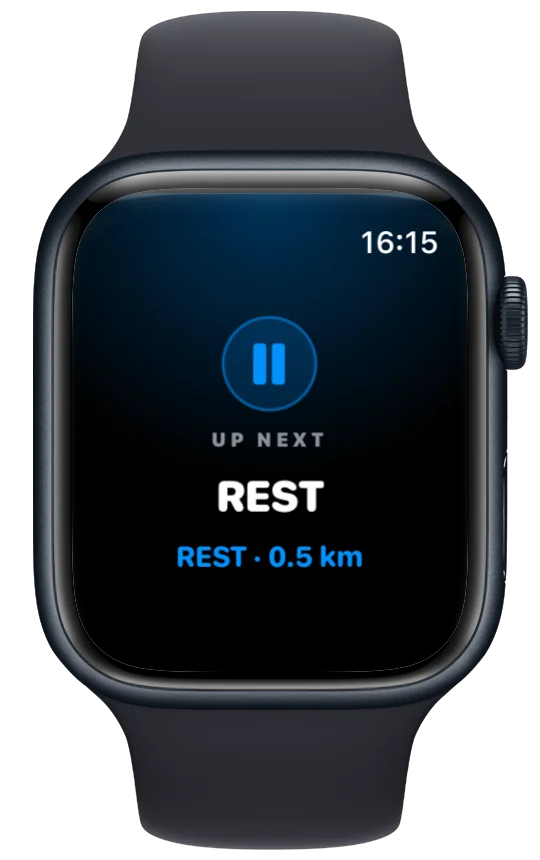
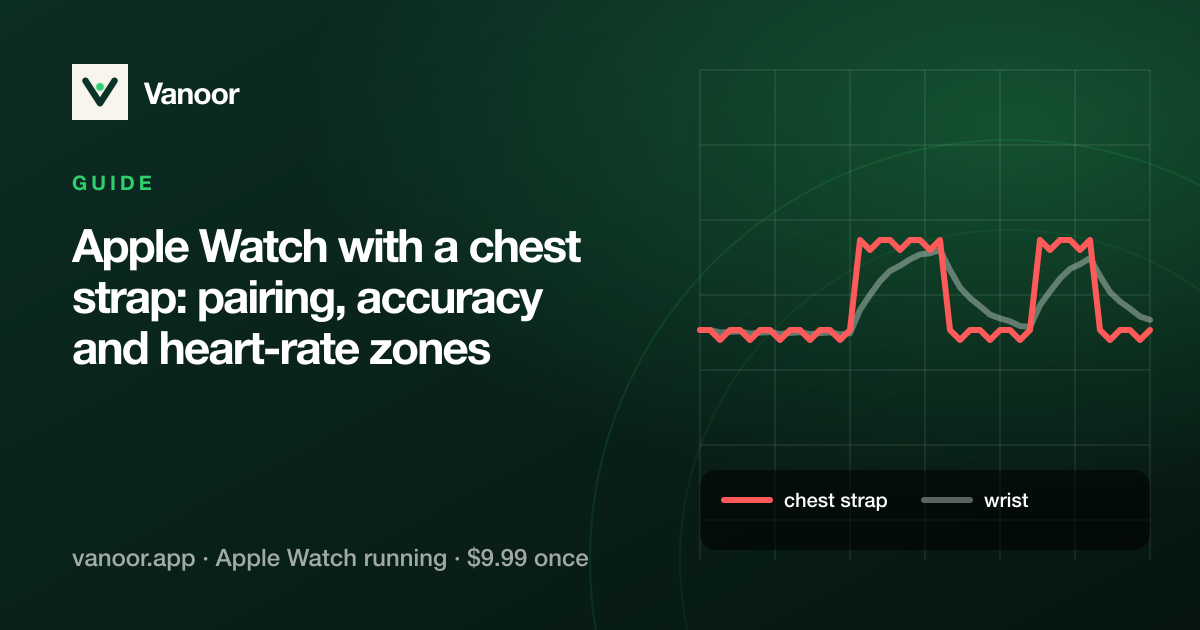
The view does not hold you in the zone. In Vanoor, a workout step can target a heart rate range (for example "45 minutes at 128–144 bpm"), and on the Watch you see where you are inside the band; switch on the Off-zone alert (Settings → Alerts) and a haptic tells you when you leave it. Build it with the calculator above and send it to Vanoor, or set it up in the app's workout editor, where steps can also target a zone or a pace. For the steadiest reading, pair a chest strap: at easy effort the wrist sensor is good, but a strap reacts faster when the terrain changes.
Zone 2 running — quick answers
What is zone 2 running?
Easy, conversational running: about 72–82% of your maximum heart rate on the five-zone scale, with low blood lactate. It builds the aerobic base every other kind of running sits on.
What is my zone 2 heart rate?
For a 35-year-old with an estimated maximum of 184 bpm, 132–151 bpm on the five-zone scale. Use the calculator above with your own age and resting heart rate, and a measured maximum if you have one.
Is 180 minus age zone 2?
Roughly the top of it, for many runners. Phil Maffetone's formula gives a maximum aerobic heart rate to stay under, with adjustments for health and training history; it is a coach's rule of thumb rather than a validated equation, so check it with the talk test.
Why is my zone 2 pace so slow?
Because most easy running is done too fast, because heart rate drifts upward on long runs and in heat, and sometimes because the estimated maximum is too high. It gets faster as the aerobic base grows.
Does Apple Watch show zone 2?
Yes. The Workout app has a Heart Rate Zones view, and you can set zones 2–4 manually under Settings → Workout → Heart Rate Zones. To be held in the zone with alerts, use a workout with a heart-rate target.
Can I walk during a zone 2 run?
Yes. If running at all pushes you out of zone 2, walk breaks keep you in it. See run/walk intervals.
References
- Seiler S. What is best practice for training intensity and duration distribution in endurance athletes? Int J Sports Physiol Perform. 2010;5(3):276–291 (Table 1). doi:10.1123/ijspp.5.3.276
- Seiler KS, Kjerland GØ. Quantifying training intensity distribution in elite endurance athletes: is there evidence for an "optimal" distribution? Scand J Med Sci Sports. 2006;16(1):49–56. doi:10.1111/j.1600-0838.2004.00418.x
- San-Millán I, Brooks GA. Assessment of metabolic flexibility by means of measuring blood lactate, fat, and carbohydrate oxidation responses to exercise in professional endurance athletes and less-fit individuals. Sports Med. 2018;48(2):467–479. doi:10.1007/s40279-017-0751-x
- Tanaka H, Monahan KD, Seals DR. Age-predicted maximal heart rate revisited. J Am Coll Cardiol. 2001;37(1):153–156. doi:10.1016/S0735-1097(00)01054-8
- Garber CE, Blissmer B, Deschenes MR, et al. American College of Sports Medicine position stand: quantity and quality of exercise for developing and maintaining cardiorespiratory, musculoskeletal, and neuromotor fitness in apparently healthy adults. Med Sci Sports Exerc. 2011;43(7):1334–1359 (the % of heart-rate reserve intensity categories). doi:10.1249/MSS.0b013e318213fefb
- Foster C, Porcari JP, Anderson J, et al. The talk test as a marker of exercise training intensity. J Cardiopulm Rehabil Prev. 2008;28(1):24–30. doi:10.1097/01.HCR.0000311504.41775.78
- Coyle EF, González-Alonso J. Cardiovascular drift during prolonged exercise: new perspectives. Exerc Sport Sci Rev. 2001;29(2):88–92. doi:10.1097/00003677-200104000-00009
- Apple. View Heart Rate Zones on Apple Watch (watchOS User Guide). support.apple.com
- Maffetone P. The MAF 180 Formula. philmaffetone.com
Sources read 28 September 2026. The calculator's Karvonen band uses 40–60% of reserve (the ACSM "moderate" category[5]), matching our heart-rate zones calculator.
Related guides
Picked by shared topics.
Keep the Watch. Upgrade the run.
Vanoor — offline route navigation, race pacing and structured workouts on the Apple Watch you already own.
Get Vanoor on the App Store 7-day free trial · $9.99 once, no subscription · no account