 Vanoor
Guide
Run/walk intervals on Apple Watch: ratios that work, and how to set the timer so it runs itself
Run/walk is the most under-rated way to run: beginners finish their first 5K with it, and plenty of marathoners use planned walk breaks to run faster overall. The problem on an Apple Watch is the timer — Apple's Workout app can do it, but only if you know where the custom workout builder is and how repeats work. Here is the method, the ratios, and the setup.
Why walk breaks work
The idea, popularised by Jeff Galloway, is simple: short, scheduled walks before you are tired keep your running form intact and your heart rate lower, so the total effort is spread more evenly. The best-known trial compared run/walk with continuous running in a marathon: Hottenrott and colleagues found the run/walk group finished in a statistically similar time, with similar average heart rate and cardiac markers, but reported less muscle pain and fatigue after the race [1]. Same result, less damage.
It also makes heart-rate training possible for new runners: if running at all pushes you into zone 4, walk breaks are how you spend time in zones 1–2 until fitness catches up.
Ratios that work
| Who | Run | Walk | Why |
|---|---|---|---|
| First weeks of running | 1 min | 2 min | Heart rate settles during the walk; you finish every session. |
| Building to a 5K | 2–3 min | 1 min | Progress by lengthening the run, keeping the walk. |
| Long runs, 10K–half | 4–5 min | 1 min | Enough running to hold rhythm; the minute resets form. |
| Marathon, planned breaks | 8–10 min | 30–60 s | Walk through aid stations; net time loss is small. |
| Trail and ultra | By terrain | Every climb | Walk the steep bits at the same heart rate you'd run the flats. |
Two rules: walk briskly (it is a break for your legs, not a stop), and walk before you need to. If the break only starts when you're gasping, the ratio is too long.
Setting up run/walk on Apple's Workout app
Since watchOS 9: Workout → Outdoor Run → ⋯ → Create Workout → Custom. Add a Work step (time) and a Recovery step (time), then Add repeat and set the count. The Watch taps your wrist at each change. Limitations worth knowing: the labels are always "Work" and "Recovery", you cannot attach a pace or heart-rate target to the walk, editing a saved workout is fiddly on the small screen, and there is no way to say "repeat until 5 km".
Setting up run/walk in Vanoor
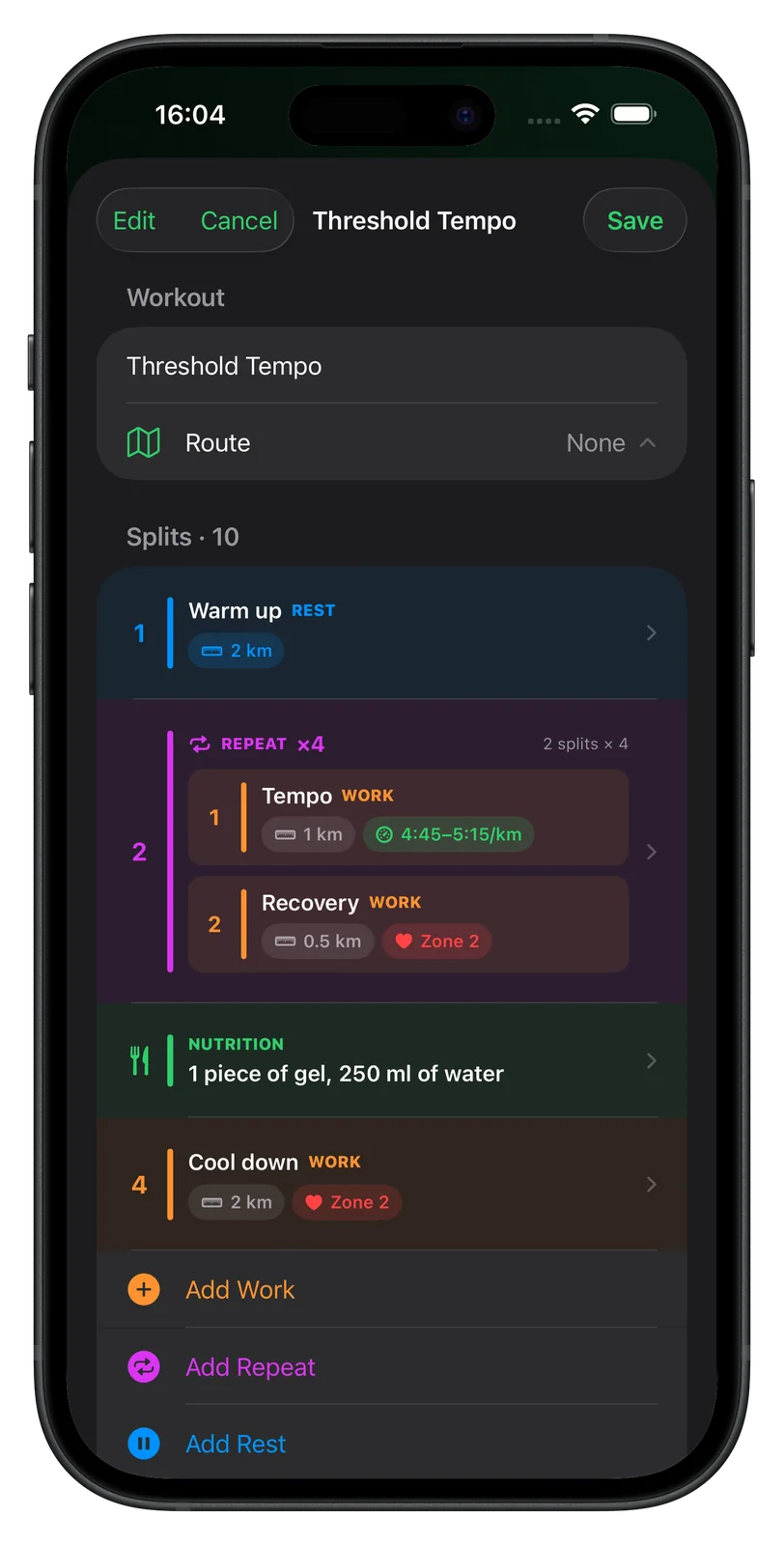
Vanoor's workout editor lives on the iPhone, so building the session takes a minute:
- Add a step: Run — 3 min. Optionally give it a heart-rate zone or pace band so the Watch tells you if you're running the run bits too hard.
- Add a step: Walk — 1 min (a recovery step; leave the target open, or set zone 1–2).
- Wrap both in a repeat block — 8× for a 32-minute session.
- Add a warm-up walk and a cool-down walk outside the block. Sync; it appears on the Watch.
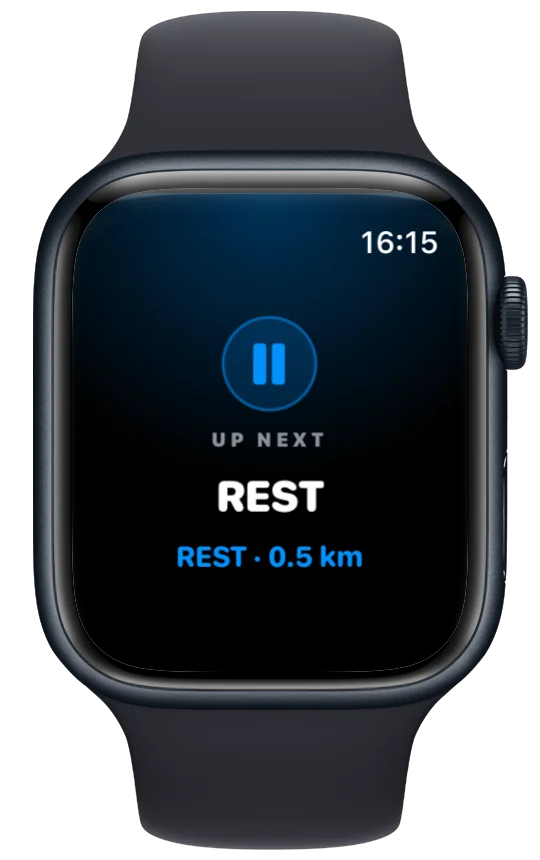
On the run the Watch shows the current step, time left and — if you set one — whether you're in the target band; a haptic marks every run-to-walk and walk-to-run change so you don't have to look. The whole session is one run in Apple Health, and it uploads to Strava as one activity with the walk breaks visible in the pace trace.
Progressing
Keep the walk at one minute and lengthen the run by 30–60 seconds each week; when you reach "run 10 / walk 1" comfortably, try a continuous 20-minute run and see how it feels. Many runners never drop the breaks entirely — and the marathon trial above is a good reason not to feel you must.
Run/walk on Apple Watch — quick answers
Does Apple Watch have a run/walk timer?
Yes, via Custom workouts in the Workout app (Work/Recovery steps with repeats), or with a third-party app like Vanoor that adds pace and zone targets, distance-based repeats and clearer haptics.
Does run/walk count as running in Apple Health and Strava?
Yes — it is one outdoor run; the walks show up as slower segments in the pace chart.
What ratio should a beginner use?
Run 1 minute, walk 2, for the first couple of weeks; then 2:1, then 3:1. Walk briskly.
Is the Galloway method slower for a marathon?
In the one controlled comparison, finish times were similar and the run/walk group hurt less afterwards [1].
References
- Hottenrott K, Ludyga S, Schulze S, Gronwald T, Jäger FS. Does a run/walk strategy decrease cardiac stress during a marathon in non-elite runners? J Sci Med Sport. 2016;19(1):64–68. doi:10.1016/j.jsams.2014.11.010
Last checked 18 September 2026.
Keep the Watch. Upgrade the run.
Vanoor — offline route navigation, race pacing and structured workouts on the Apple Watch you already own.
Get Vanoor 7-day free trial · $9.99 once, no subscription · no account